
BTC+ Sophon Quant Vault White Paper

Updated: May 8
AI Agent-ready Crypto Allocation Strategy on Hyperliquid

Executive Summary
BTC+ Sophon Quant is a quantitative crypto strategy delivered through a Hyperliquid Vault. The strategy is designed for investors seeking systematic crypto allocation beyond simply holding BTC.
The objective of the strategy is to pursue improved long-term risk-adjusted returns versus BTC through a two-layer portfolio structure:
First, a Risk Parity Smart Beta module. This module replaces single-asset BTC exposure with a diversified crypto beta portfolio across major tokens. Through dynamic position sizing and risk-based allocation, it seeks to reduce single-asset concentration risk while maintaining exposure to the broader crypto market.
Second, a Long/Short Factor Alpha module. This module builds long-short portfolios from liquid crypto tokens based on factors grounded in market logic, aiming to capture relative strength, capital flows, positioning, and structural differences across tokens.
Backtest results using data from 2020 to 2025 suggest that this strategy would have generated an annualized excess return of 26.4% over BTC, with better sharpe ratio and improved max drawdown. Overall, BTC+ Sophon Quant is designed to serve as a transparent, systematic, and AI Agent-ready crypto allocation strategy.
Overview
Strategy Name: BTC+ Sophon Quant
Platform: Hyperliquid Vault
Strategy Manager: Sophon Capital, a BVI approved manager
Denomination Asset: USDC
Core Strategy: Risk Parity Smart Beta + Factor Alpha
Primary Market: Liquid crypto perpetual contracts and eligible crypto instruments
Access: Subject to investor eligibility, applicable laws, and platform rules. Contact Sophon Capital for detail.
What is a Hyperliquid Vault?
A Hyperliquid Vault can be understood as an on-chain strategy account. Investors allocate capital into a Vault to gain exposure to a strategy operated by the Vault leader or strategy manager.
For investors, the core value of a Vault lies in four areas:
First, lower operational barriers. Investors do not need to research multiple tokens, execute trades manually, rebalance positions, or manage risk controls on their own. A Vault provides access to a systematic crypto strategy through a single on-chain structure.
Second, greater transparency. The Vault page provides a public monitoring layer for strategy performance, including information such as returns, positions, trading history, and other account-level metrics. Investors can observe trade activities, strategy performance, position changes, and historical activity more directly and more freequently.
Third, improved fund-flow transparency. Investors do not transfer assets to the manager’s custody. Instead, participation occurs through the Hyperliquid Vault structure, a smart contract. This reduces certain traditional manager custody risks, while investors should still understand platform, smart contract, trading, and liquidation risks.
Fourth, more flexible liquidity. Vault structures are generally more flexible than traditional closed-end fund structures when there are liquidity needs.
Functionally, a Vault can resemble an on-chain, transparent, monitorable, ETF-like crypto allocation vehicle. However, BTC+ Sophon Quant Vault is not a publicly registered investment product in any jurisdiction.
Why Vaults Are Suitable for AI Agent Usage and Automated Crypto Allocation
AI Agents are expected to play a growing role in payments, treasury management, and automated portfolio allocation. Since AI Agent payment and fund management are naturally wallet-based, idle wallet balances may eventually need transparent, liquid, and risk-managed allocation tools.
For AI Agent investing and automated crypto allocation, an ideal investment vehicle must meet three conditions: data transparency, high liquidity, and wallet-native integration. For these reasons, one suitable product form for AI Agent-ready crypto allocation is a crypto-native Smart Beta ETF-like strategy vehicle.
A Vault aligns precisely with this direction: it makes strategy NAV, positions, and trading activity easy to read and monitor while preserving crypto-native deposit and withdrawal methods. BTC+ Sophon Quant is a strategy designed to match this structure. The strategy primarily focuses on liquid crypto assets, seeks to avoid reliance on small-cap or low-capacity opportunities, and combines a Smart Beta crypto allocation layer with a long-short Factor Alpha layer.
In this sense, BTC+ Sophon Quant is designed as a crypto allocation sleeve for investors and a potential building block for future AI Agent-driven portfolio allocation.
Strategy Overview
Crypto markets are highly correlated during broad market moves. Most major tokens tend to rise and fall together when risk appetite changes. However, different tokens still show meaningful differences in relative strength, capital flows, positioning, liquidity, and lifecycle behavior. These differences are potential sources of Alpha.
BTC+ Sophon Quant uses a two-layer structure:
Risk Parity Smart Beta Strategy
This serves as the foundational Beta layer, providing diversified long exposure to major crypto assets.
Long/Short Factor Alpha Strategy
This serves as the Alpha layer, capturing relative performance differences across tokens through systematic selections.
The strategy can be summarized as:
BTC+ Return = Crypto Risk Parity Beta + Long/Short Factor Alpha
5.1 Risk Parity Smart Beta Strategy
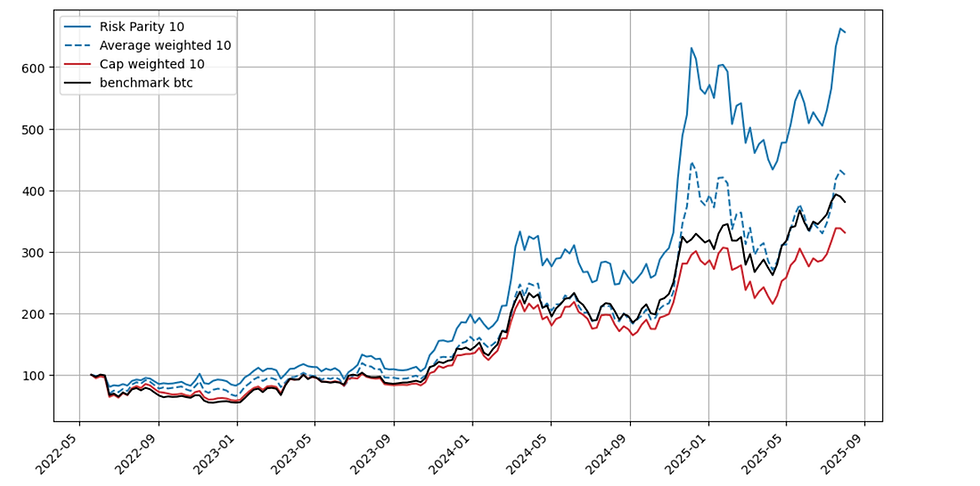
The Risk Parity Smart Beta module is the core allocation layer of the strategy. Its objective is to replace single BTC exposure with diversified crypto beta across multiple major tokens. The module maintains long crypto market exposure, but does not passively hold tokens by market capitalization. Instead, total position sizing may adjust dynamically with market volatility: when volatility is relatively low and market conditions are stable, the portfolio may increase risk exposure; when volatility rises or systemic risk increases, the portfolio may reduce exposure.
Within the portfolio, token weights are determined mainly by two factors:
Individual token volatility: higher volatility generally leads to lower weight.
Correlation between tokens: higher correlation generally reduces diversification value.
During research, the team used PCA testing to evaluate which tokens may provide diversification value. The team also used backtesting to evaluate volatility targets and portfolio construction rules.
Historical backtests may show that, under certain sample periods and parameter assumptions, a risk parity portfolio can achieve a higher return-to-risk ratio than a single BTC holding. However, backtest results do not represent future performance.
5.2 Factor Alpha Strategy
The Factor Alpha Strategy is the return-enhancement layer of the product. It aims to capture relative value, capital flow, and positioning differences across crypto tokens.
The module focuses on liquid crypto tokens and excludes assets with insufficient liquidity, excessive transaction costs, unstable data quality, or limited trading capacity.
The currently validated effective factors include:
Momentum Factor: Momentum seeks to capture relative strength trends across tokens. The strategy may go long tokens showing persistent strength and short tokens showing persistent weakness.
Backtest Example

Crowding Factor: Crowding and positioning factors seek to identify crowded trades and potential reversal risks. When long or short positions become overly concentrated, the strategy may use factor signals for risk control or reversal opportunities.
Backtest Example

Capital Flow and Attention Factor: Capital flow, market attention, and increased participations can influence future token performance. The strategy seeks to capture opportunities arising from capital inflows, rising attention, or changes in market participation.
Backtest Example

Value Factor: Holding tokens can generate yield-like returns and such return potentials influence token price movements. The strategy identifies tokens with insufficient pricing or more attractive relative value.
Backtest Example

All factors must satisfy two standards:
First, they must be grounded in clear market logic, not purely backtest-driven results.
Second, they must be tradable at scale in real markets, with consideration for liquidity, slippage, transaction costs, funding costs, and capacity.
Research and Validation
Our research process follows an institutional-grade quantitative framework. It emphasizes long-period data, strict in-sample and out-of-sample testing, robustness analysis, and live trading executability.
During strategy development, historical data is divided into in-sample and out-of-sample periods. In-sample data is used for hypothesis generation, factor screening, parameter design, and portfolio construction. Out-of-sample data is used to evaluate whether the strategy remains effective on data not used during model development.
This process is designed to reduce overfitting risk and assess whether the strategy logic has persistence across different market environments.
Our research focuses on three areas:
First, long-period crypto market validation.
Crypto markets have experienced multiple bull and bear cycles, liquidity expansions and contractions, extreme liquidation events, and structural changes. Strategy design should not rely on one single market regime.
Second, robustness of strategies.
We test different trading universes, rolling windows, parameter sets, and factor definitions to reduce reliance on one fragile parameter combination.
Third, real-market executability.
A strategy must not only perform well in backtests but also account for liquidity, slippage, fees, funding rates, market capacity, and exit feasibility under extreme market conditions.
Risk Management and Key Risks
Risk management is not based on the assumption that models are always correct. Instead, it focuses on reducing exposure when models fail, market conditions change abruptly, or live performance deviates from expectations.
Sophon Capital team applies a multi-layered risk management framework across individual strategies, the overall portfolio, and the broader market environment.
At the single-strategy level, we monitor returns, drawdowns, volatility, transaction costs, win rate, turnover, and live performance deviation. If a sub-strategy shows persistent weakness, abnormal drawdown, rising trading costs, or clear deviation from historical behavior, the manager may reduce allocation, pause trading, or apply stop-loss rules.
At the portfolio level, we monitor NAV, maximum drawdown, volatility, net exposure, single-token risk exposure, leverage, and cross-strategy correlations. In high-volatility or high-correlation regimes, diversification can weaken, and the portfolio may reduce risk exposure.
At the market level, we monitor crypto market volatility, liquidity, funding costs, liquidation pressure, major-asset correlations, risk appetite, and extreme event risks.
Key risks include but are not limited to: market risk, leverage and liquidation risk, liquidity risk, strategy failure risk, platform risk, execution risk, regulatory risk, and force majeure.
Investors should fully understand the high-risk nature of crypto assets and quantitative trading strategies. This product does not guarantee fixed returns, nor does it promise to outperform BTC. The strategy objective is to consistently pursue risk-adjusted returns superior to BTC’s, under a framework of rigorous risk management and long-term quantitative research.
Disclosure and Transparency
The Hyperliquid Vault provides a public monitoring layer for strategy performance. Investors can use the Vault page as the primary source of transparency, while Sophon Capital can further provide supplementary reports on risk metrics, return attribution, and benchmark comparisons.
Accesss and Eligibility
BTC+ Sophon Quant Vault is not offered to the general public. Access may be available only to eligible investors who satisfy applicable laws, regulations, platform requirements, and Sophon Capital’s internal suitability review.
Investors who wish to learn more about the strategy, eligibility requirements, risk disclosures, or operational process may contact Sophon Capital directly.
Participation in any Vault or related strategy should only occur after the investor has reviewed relevant materials, understood the risks of crypto assets, perpetual contracts, quantitative strategies, and on-chain Vault structures, and independently determined that the strategy is suitable for their own circumstances.
Conclusion
BTC+ Sophon Quant is designed to provide investors with a more systematic, transparent, and long-term-oriented approach to crypto allocation.
We use Hyperliquid Vault as the product infrastructure because it is well suited to crypto-native allocation, offering greater transparency, liquidity, and on-chain monitoring. We pair this infrastructure with a Risk Parity Smart Beta + Long/Short Factor Alpha strategy framework, seeking to participate in the long-term growth of the crypto market while reducing concentration risk from single BTC exposure and capturing relative Alpha opportunities across tokens.
The objective of this product is not to promise fixed returns, but to help investors pursue long-term, stable risk-adjusted returns through suitable infrastructure and a research-driven quantitative strategy framework.
For more information and detail regarding this topic, contact Sophon Capital to access detailed research reports:
Disclaimer
This page is for informational and educational purposes only. This page does not constitute an offer, solicitation, recommendation, investment advice, or financial promotion to buy, sell, subscribe to, or participate in any securities, fund interests, virtual assets, derivatives, or other financial products in any jurisdiction.
BTC+ Sophon Quant Vault is intended only for eligible investors who satisfy applicable legal, regulatory, platform, and suitability requirements. Crypto assets, perpetual contracts, quantitative strategies, and on-chain Vault structures involve significant risks, including the potential loss of capital. Past performance, backtests, research results, and strategy examples do not guarantee future results.


Comments